




A few years ago, producing a single branded video required a production crew, studio time, and a budget most small businesses simply did not have. In 2026, the AI video generator market changed that reality entirely. What once took weeks now takes minutes, and what once cost thousands now costs a monthly subscription. This is not a slow evolution; it is a full-scale disruption that is reshaping how brands communicate, how marketers operate, and how content reaches audiences across every digital platform. The businesses paying attention are not just saving time; they are gaining a competitive edge that compounds with every video they produce.
The numbers behind this shift are hard to ignore. According to Grand View Research Inc., the global AI video generator market is projected to reach USD 3,441.6 million by 2033. Three forces are driving this rapid growth. First, the explosion of short-form video content across social platforms has made volume a non-negotiable for any brand that wants to stay visible. Second, the rise of personalized content expectations means static, one-size-fits-all video no longer cuts through. Third, AI technology itself has matured rapidly; what early tools produced in 2021 looks unrecognizable compared to what today’s platforms generate in a single prompt. These three forces, converging at once, explain why the AI video generator industry is not just growing; it is accelerating
How the AI Video Generator Market Is Transforming Digital Marketing Forever?
Think back to 2020. A brand needed a video for a product launch, and the process began with a brief to an agency, concept development, location scouting, shooting days, and weeks of post-production. By the time the video was live, the trend it was designed to capture had already moved on. In 2026, that entire cycle has been compressed into an afternoon. AI video generators have not just made video production faster; they have fundamentally changed what digital marketing looks like at its core. Marketers who previously published one or two videos a month now operate content calendars with daily output, each video personalized, on-brand, and ready to deploy across platforms without touching an editing suite.
What makes this transformation permanent rather than a passing trend is what AI video has done to the creative barrier. Personalization at scale was a concept marketing teams talked about for years, but rarely achieved. Today, brands are generating hundreds of video variants from a single script, each adapted for a different audience segment, language, or platform format, without a single additional hour of production time. Tools like Synthesia, used by tens of thousands of businesses worldwide, allow companies to update a video in minutes rather than reshooting from scratch. That kind of agility is no longer a feature; in 2026, it is the standard expectation.
AI Video Generators vs. Traditional Video Production: The Real Comparison
The conversation in 2026 is not about whether AI video generators are good enough. That debate is settled. The real conversation is about knowing where each approach best serves the work. Traditional video production has not disappeared; it has found its lane. High-stakes brand films, cinematic storytelling, and campaigns that require real human emotion on screen still benefit from a human crew and a skilled director. But for everything else, and that is the vast majority of what brands actually publish day to day, AI video generators have proven themselves the smarter, faster, and more cost-effective choice.
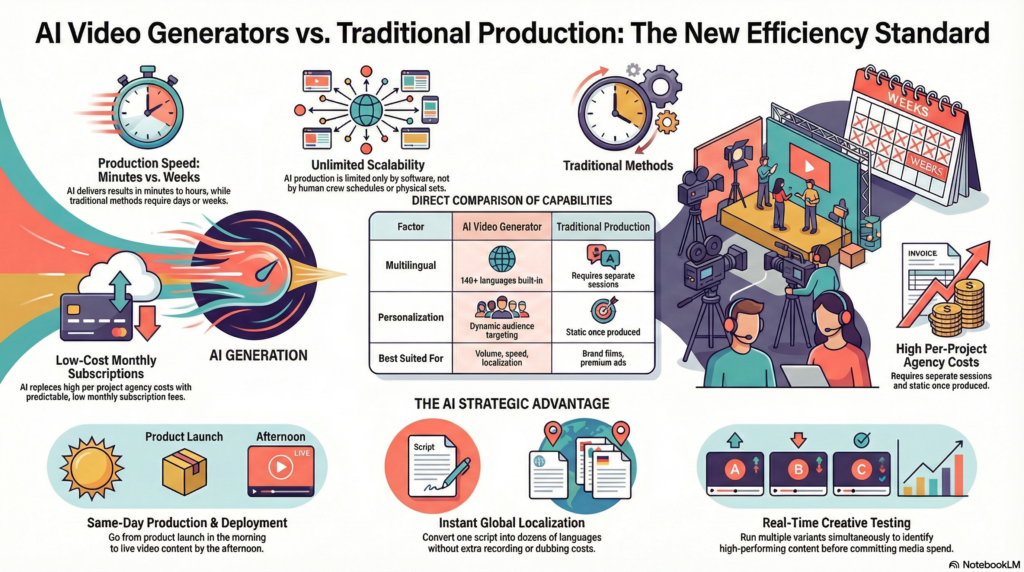
Before AI video tools reached their current maturity, a mid-size business producing localized video for three regional markets was looking at three separate shoots, three sets of voiceovers, and three rounds of editing. In 2026, the same output is generated by a single script and completed in hours. The growth of the AI video generator market has made this kind of scale not just possible but expected. The cost reduction is real, the speed advantage is real, and for businesses that need volume, the scale advantage is simply not comparable. Traditional production cannot replicate what AI delivers in that scenario, and most marketing teams have already made the shift.
| Factor | AI Video Generator | Traditional Production |
| Production Time | Minutes to a few hours | Days to several weeks |
| Cost Per Video | Low monthly subscription cost | High per-project cost |
| Scalability | Unlimited at no extra time cost | Limited by crew and schedule |
| Multilingual Output | Built-in, 140 plus languages | Requires separate sessions |
| Personalization | Dynamic, audience-level targeting | Static once produced |
| Creative Depth | Improving rapidly | High, human-led nuance |
| Best Suited For | Volume, speed, localization | Brand films, premium ads |
AI Video Generator Market: The End of Human Video Editors?
The debate around AI replacing human video editors is no longer hypothetical; the answer is here, and it is more nuanced than either side predicted. AI has not replaced human video editors, but it has permanently changed what editing as a profession looks like and which parts of the workflow still require human judgment.
Every repeatable, rule-based task in the editing process has already been automated. The efficiency gains are not incremental; they are transformational:
- Silence removal: AI detects and cuts dead air instantly across any length of footage.
- Caption generation: Accurate, synced captions are produced automatically without manual timestamping.
- Audio syncing: Background music and voiceovers align to visuals without a single manual adjustment.
- Color grading: Scene-by-scene color correction is applied in seconds based on detected lighting conditions.
- Scene sequencing: Raw footage is assembled into a logical narrative flow without human review of every clip.
Where human editors remain irreplaceable is in decisions that require taste and intent. Knowing when to hold a shot longer because the emotion in the frame earns it. Recognizing when a conventional cut structure needs to be broken to create tension.
These are judgment calls rooted in storytelling experience, not in processing power, and no AI model has yet reliably demonstrated that capability. The professionals thriving right now are those who have moved upstream into creative direction, using artificial intelligence to handle execution while they focus on the decisions that truly differentiate one video from another.
The Risk Behind AI Video That Could Cost You Everything
Artificial intelligence did not just open a new chapter in content creation; it quietly handed bad actors a weapon that is proving very difficult to contain. Deepfake AI video technology, running on the same generative foundations that power every legitimate tool in the AI video generator market today, can now produce footage of real people saying things they never said, in voices they never used, in situations that never happened. The gap between what is real and what is fabricated has never been smaller, and the consequences of that gap are landing on businesses, public figures, and everyday users in ways that are growing harder to ignore with every passing month.
For anyone building a strategy inside the AI video generator market right now, this is not a distant regulatory problem; it is an immediate operational one. Platform policies are tightening, disclosure laws are advancing at the state and federal levels across the United States, and brands that associate with AI-generated video content that crosses ethical lines are facing audience backlash that no paid campaign can repair. The technology itself is not the threat. Operating inside it without a clear internal policy on what your brand will and will not produce is where the real risk lives, and in 2026, that distinction is the difference between a brand that grows with this market and one that gets burned by it.
Same Tool, Two Outcomes: Small Businesses Choose Profit
The same generative AI technology enabling deepfake abuse is the exact technology smart small businesses are using to build content empires on a fraction of a traditional marketing budget. The choice has never been about the tool; it has always been about intent. While bad actors exploit AI video to deceive, small businesses across the United States are using it to compete at a level that was completely out of reach just a few years ago. Headway, a Ukrainian edtech startup, is a real example of this in action by deploying HeyGen for video localization across multiple regional markets. The company reported a significant improvement in ROI from video advertising, a result that would have required a substantially larger budget under traditional production methods.
What small businesses are doing right now to turn AI video into profit
- Launching same-day: The product goes live in the morning, and its video is published by afternoon, without any external vendors involved.
- Eliminating localization costs: One script becomes multilingual video content across multiple markets without additional recording or dubbing sessions.
- Publishing consistently: Weekly content calendars that were previously impossible to sustain are now standard in the workflow.
- Testing before spending: Multiple creative variants are produced and tested before committing media budget to a single version.
- Competing at the agency level: Solo founders and small teams are producing brand video quality that previously required a full production house and a significant retainer.
AI Video Generator Market: The Next Frontier That Will Change Everything
The AI video generator market in 2026 is not at its ceiling; it is accelerating toward something larger. Real-time personalized video, where AI generates and delivers a unique video to each viewer at the exact moment of interaction, is no longer theoretical. The infrastructure is being built now, and the businesses, marketers, and creators who are building their AI video capabilities today are positioning themselves to lead when that next phase arrives. The window to establish a competitive advantage in this market is open. The only question is whether you move now or spend the next two years catching up.
















One Comment