



Key Highlights:
- The Agentic AI Market is rapidly shifting from AI assistants to fully autonomous enterprise systems.
- Healthcare providers are using AI agents to reduce administrative burdens and improve patient care.
- Multi-agent collaboration is becoming the core architecture powering the modern Agentic AI market.
- Banks are deploying autonomous agents for fraud detection, compliance, and financial operations.
- Trusted governance and sovereign AI are emerging as major priorities in the global Agentic AI market.
- Retail companies are leveraging agentic AI for hyper-personalized shopping and real-time pricing optimization.
- Logistics firms are building self-healing supply chains using autonomous AI-driven decision systems.
What if your next employee is not human, but an AI system that can think, plan, collaborate, and execute tasks on its own? That question is no longer theoretical. In 2026, the agentic AI market is rapidly evolving from experimentation into enterprise-scale deployment, with autonomous AI agents becoming central to operations across healthcare, finance, retail, logistics, and customer service.
The agentic AI industry is witnessing explosive momentum as businesses move beyond traditional chatbots and generative AI assistants toward intelligent systems capable of autonomous decision-making. Unlike conventional AI tools that require constant prompts, agentic AI systems can independently analyze goals, break down workflows, coordinate with other agents, and continuously optimize tasks. Enterprises are now investing heavily in multi-agent systems, AI orchestration platforms, and autonomous enterprise operations to improve efficiency, reduce costs, and unlock real-time decision intelligence.
According to recent enterprise surveys and industry reports, organizations worldwide are aggressively scaling agentic AI initiatives in 2026. Grand View Research estimates that the global agentic AI market could reach nearly USD 182.97 billion by 2033, driven by rising enterprise adoption of autonomous AI agents across workflow automation, customer operations, cybersecurity, and productivity enhancement. Growing investments in AI governance, sovereign AI infrastructure, and agent-to-agent collaboration frameworks are further accelerating market expansion.
From Chatbots to Co-Workers: What Agentic AI Actually Means in 2026
Agentic AI refers to autonomous AI systems capable of pursuing objectives with minimal human supervision. These AI agents are designed to reason, plan, execute tasks, use tools, retrieve data, and adapt dynamically to changing environments. In 2026, businesses are increasingly treating AI agents as digital co-workers rather than simple automation software.
Traditional AI systems respond to prompts. Agentic AI systems, however, operate with goals and memory. They can coordinate multiple steps, interact with APIs, communicate with other agents, and manage workflows independently. This shift is transforming enterprise productivity and redefining how organizations approach digital operations.
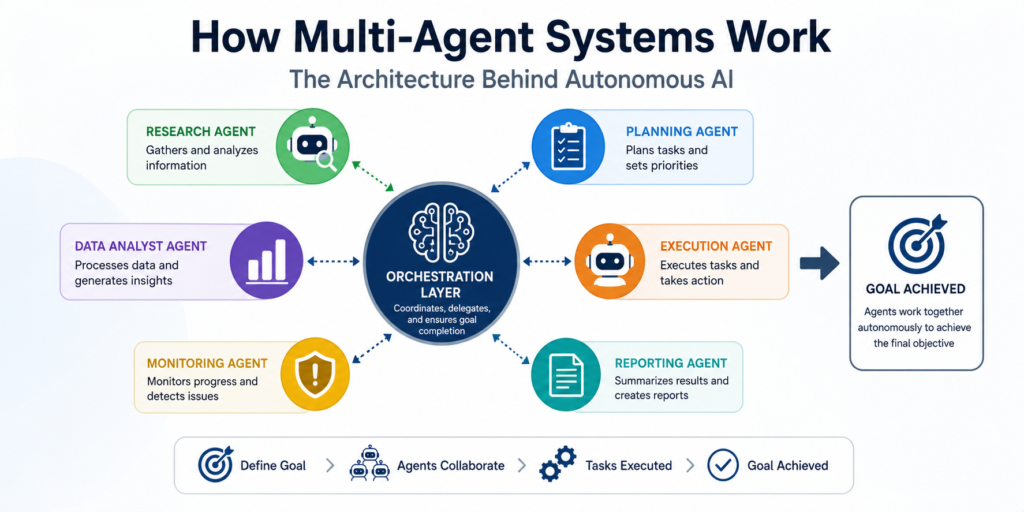
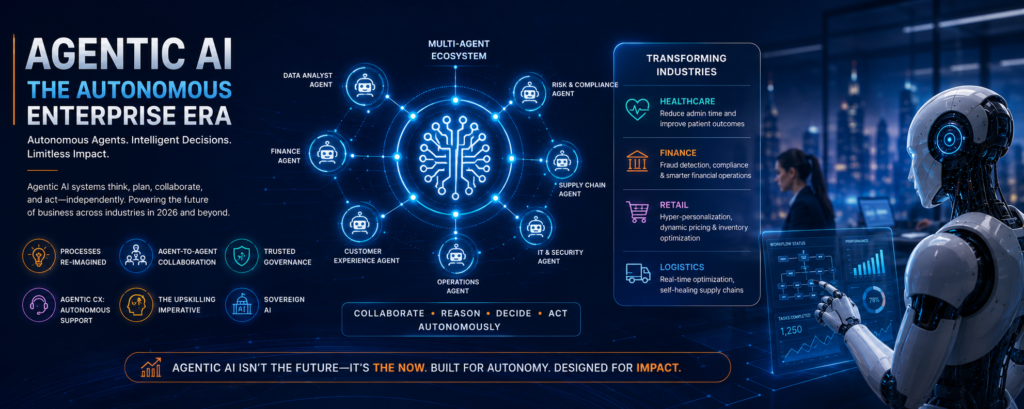
The biggest evolution in the agentic AI market is the rise of multi-agent ecosystems. Instead of relying on a single AI assistant, enterprises are deploying specialized agents for research, compliance, analytics, cybersecurity, procurement, and customer engagement. These systems work collaboratively to create a highly scalable, autonomous enterprise architecture.
How Multi-Agent Systems Work: The Architecture Behind Autonomous AI
Modern agentic AI platforms operate through interconnected systems in which multiple AI agents collaborate to achieve business objectives. These frameworks combine reasoning engines, memory systems, orchestration layers, APIs, enterprise software integrations, and governance protocols. Key components driving the agentic AI market in 2026 include:
- Multi-Agent Collaboration: Specialized AI agents coordinate tasks across departments and workflows.
- Agent-to-Agent Communication (A2A): AI systems exchange information and delegate responsibilities autonomously.
- Process Re-Imagining: Businesses are redesigning workflows to automate execution rather than rely on manual approvals.
- Trusted Governance: Enterprises are investing in AI compliance, observability, and security frameworks.
- Agentic CX: AI-powered customer experience systems now resolve complex support tasks independently.
- Upskilling Imperative: Companies are training employees to manage, supervise, and optimize AI-driven workflows.
- Sovereign AI: Nations and enterprises are building region-specific AI infrastructure to control data and ensure regulatory compliance.
AI Revolution No One Saw Coming: The Autonomous Enterprise Era
The enterprise AI conversation has shifted dramatically in 2026. Businesses are no longer asking whether AI can assist employees; they are asking how. Instead, they are asking which workflows can be fully autonomous. This transition is ushering in what many analysts now call the “Autonomous Enterprise Era,” in which AI agents continuously monitor operations, identify problems, make decisions, and execute actions in real time.
Large enterprises are already deploying agentic AI systems across IT operations, procurement, finance, HR, and cybersecurity. Companies are integrating AI agents into existing enterprise software ecosystems to automate repetitive workflows and improve operational resilience. The growing focus on AI orchestration, governance, and reliability reflects the industry’s shift from pilot projects to production-scale deployments.
Agentic AI in Healthcare: Cutting Admin Time and Redefining Patient Care
Healthcare providers are increasingly embracing autonomous AI agents to tackle one of the industry’s biggest challenges: balancing operational efficiency with high-quality patient care. In 2026, hospitals, clinics, and healthcare networks are deploying agentic AI systems to reduce administrative overload, minimize clinician burnout, improve diagnostic accuracy, and enhance patient engagement. These intelligent systems can independently manage workflows, analyze medical data in real time, coordinate care processes, and support healthcare professionals in making faster decisions. From streamlining clinical documentation to accelerating medical research, agentic AI is becoming a critical force behind the digital transformation of modern healthcare systems.
Key applications of AI in the healthcare market include:
- Patient Scheduling & Claims Processing: AI agents automate appointment bookings, insurance verification, billing workflows, and claims management to reduce delays and administrative errors.
- Clinical Documentation Support: Autonomous systems assist doctors by generating medical summaries, updating patient records, and reducing time spent on paperwork.
- Real-Time Patient Monitoring: AI-powered agents continuously analyze patient data to detect health risks early and support proactive medical interventions.
- Drug Discovery & Medical Research: Intelligent AI systems accelerate research workflows by analyzing massive datasets, identifying patterns, and supporting faster drug development.
- Hospital Resource Optimization: Agentic AI improves staff allocation, bed management, equipment utilization, and operational efficiency across healthcare facilities.
Agentic AI in Finance: How Banks Are Putting Autonomous Agents to Work Every Day
Financial institutions are rapidly adopting agentic AI to automate decision-heavy workflows while improving compliance and fraud detection capabilities. Autonomous agents are transforming banking operations from customer onboarding to risk management. These AI systems are also helping banks deliver faster customer support and more accurate financial insights through real-time data analysis. As adoption grows, financial firms are investing heavily in secure AI infrastructure and governance frameworks to ensure transparency and regulatory compliance.
Major use cases of agentic AI in finance include:
- Real-time fraud monitoring and transaction analysis
- AI-driven financial reporting and auditing
- Automated loan processing and underwriting
- Personalized investment and wealth management services
- Continuous compliance monitoring and regulatory reporting
Agentic AI in Retail: The Technology Behind Profit Gains and Hyper-Personalized Shopping
Retailers are leveraging the agentic AI market to create intelligent shopping ecosystems that adapt to customer behavior in real time while improving operational efficiency across stores and digital platforms. AI agents are now acting as autonomous retail strategists, helping brands optimize merchandising, customer engagement, and inventory decisions without constant human intervention.
In 2026, retailers are increasingly integrating autonomous AI systems into omnichannel operations to improve customer retention and maximize profitability. These AI-driven platforms are also helping businesses predict consumer demand patterns more accurately and respond instantly to changing market trends.
Retail applications of agentic AI in retail include:
- Hyper-personalized product recommendations based on customer behavior and preferences
- Dynamic pricing optimization using real-time market and competitor analysis
- Autonomous inventory forecasting and automated stock replenishment systems
- AI-powered customer service agents and virtual shopping assistants for seamless support
- Omnichannel campaign management with predictive analytics for targeted marketing
- Smart shelf monitoring and in-store analytics powered by autonomous AI agents
- Demand forecasting and supply chain coordination to reduce delays and inventory waste
Agentic AI in Logistics: Building Supply Chains That Think, React, and Self-Heal in Real Time
Supply chain operators are using autonomous AI agents to build adaptive logistics networks that can respond instantly to disruptions. These systems improve efficiency, reduce downtime, and enhance forecasting accuracy.
AI-powered logistics platforms can also identify bottlenecks before they escalate into major operational issues. As global trade networks become more complex, autonomous agents are helping companies maintain resilience and agility in real time.
Key logistics applications of agentic AI in logistics include:
- Real-time route optimization and fleet management
- Predictive maintenance for transportation infrastructure
- Autonomous warehouse operations and inventory tracking
- Risk detection across global supply chains
- AI-driven demand forecasting and procurement planning
Can Agentic AI Replace Repetitive Human Decision-Making?
In many enterprise environments, agentic AI is already replacing repetitive, rules-based decision-making processes. Tasks such as ticket routing, invoice approvals, compliance checks, customer onboarding, and workflow orchestration are increasingly managed autonomously by AI systems.
However, the future of the agentic AI market is not about removing humans entirely. Instead, businesses are building hybrid operational models in which humans supervise high-risk decisions while AI agents handle repetitive execution tasks. Governance, transparency, and human oversight remain critical for enterprise adoption.
Challenges remain regarding reliability, security, hallucinations, compliance, and AI accountability. Industry experts emphasize that enterprises must balance autonomy with governance as AI agents gain more operational authority. This is why trusted governance and sovereign AI frameworks are becoming major enterprise priorities in 2026.
What Lies Ahead for the Agentic AI Market Beyond 2026?
The agentic AI market is entering a defining phase where autonomous agents are evolving into the digital operating layer of modern enterprises. As multi-agent systems, AI governance frameworks, and enterprise orchestration platforms mature, businesses will increasingly rely on AI agents not just for productivity but for strategic execution, decision intelligence, and operational resilience. In the years ahead, the organizations that successfully combine autonomy with trust, governance, and human collaboration will lead the next generation of enterprise transformation.