




Key Highlights
- Agentic AI is shifting healthcare from reactive systems to autonomous, always-on decision-making that acts before humans intervene.
- Unlike traditional AI, agentic AI continuously perceives, reasons, and executes multi-step actions without waiting for prompts.
- Healthcare is seeing rapid adoption, with the agentic AI market projected to grow from $538 million to nearly $5 billion by 2030.
- From drug discovery to hospital operations, agentic AI is compressing timelines, improving accuracy, and freeing clinicians from administrative burden.
- The true value of agentic AI lies not in replacing clinicians, but in enabling proactive, precise, and continuously improving patient care.
On a long weekend in February of this year, at approximately 2:47 a.m., a 68-year-old cardiac patient at a reputed clinic began showing early signs of atrial deterioration, a subtle pattern that a fatigued nightshift nurse might easily attribute to routine fluctuation. But an agentic AI system monitoring the patient’s vitals did not sleep, did not get fatigued, and did not consider anything routine. Within eleven seconds, it cross-referenced the waveform anomaly against the patient’s three-year medication history, flagged a probable drug interaction with a recently adjusted beta-blocker, escalated a priority alert to the on-call cardiologist, and prepopulated a suggested intervention protocol, all before any human had picked up a phone. The cardiologist arrived, reviewed, and concurred. A crisis was averted before it became one.
This is not a thought experiment. It is a preview of what healthcare looks like when AI stops answering questions and starts taking action.
What Exactly Is Agentic AI?
The term “agentic AI” has arrived in boardrooms, hospital corridors, and policy papers with the kind of velocity that usually outpaces understanding. So before anything else, let us be precise.
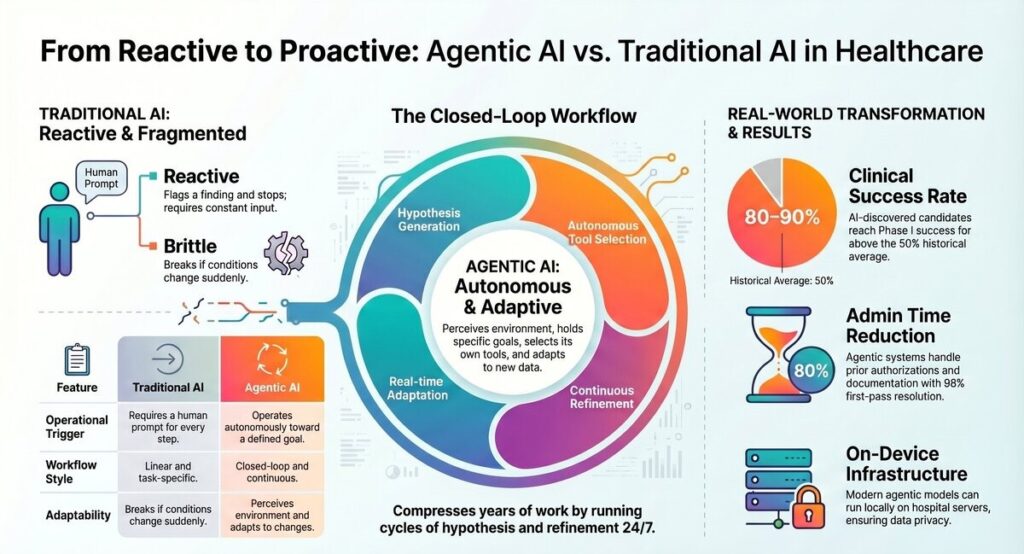
Traditional AI systems are fundamentally reactive. You ask, they answer. Feed an AI a chest X-ray and it tells you whether it sees a nodule. Ask it to summarize clinical notes and it produces a paragraph. The intelligence is genuine, but the agency is zero. The system cannot act on what it knows. It waits, perpetually, to be asked again.
An AI agent represents a step up from this. An AI agent can be given a goal, break it into a sequence of steps, and pursue those steps, but typically within a single defined pipeline.
| AI AGENT | AGENTIC AI |
| Receives instructions each time | Perceives context independently |
| Follows a defined, fixed pipeline | Sets own goals and selects tools dynamically |
| Executes single-step tasks | Plans and executes multi-step workflows |
| Returns output and stops | Adapts, continues and self-revises |
| Dependent on constant human input | Operates autonomously within defined limits |
Agentic AI is something categorically different. It is not a tool executing a workflow. It is a reasoning entity operating with genuine autonomy across dynamic, unpredictable environments. Agentic AI perceives context, forms goals, selects tools from a broader ecosystem, adjusts its behavior when circumstances change, and takes multistep action across time, often without waiting for human instruction at each juncture.
Agentic AI in Healthcare Market on the Verge of Explosion
Nearly three-quarters of global pharmaceutical organizations are actively planning, piloting, or deploying agentic AI initiatives. NVIDIA’s healthcare and life sciences startup program has grown to over 5,000 members and the $4.9 trillion healthcare industry is deploying AI at more than twice the rate of the broader economy.
| $538M Agentic AI Healthcare (2024) | $4.96B Projected 2030 (45.6% CAGR) | $160B AI Drug Discovery by 2035 | 73% Pharma orgs deploying agentic AI |
| Grand View Research | Grand View Research | DeepCeutix, 2026 | Capgemini / Medable, 2025 |
The global agentic AI in healthcare market was estimated at USD 538 million in 2024 and is projected to reach USD 4.96 billion by 2030, growing at a CAGR of 45.56%, making it one of the fastest-expanding technology segments anywhere in the global economy. The AI-powered drug discovery market separately is projected to grow from $19.89 billion to $160.49 billion by 2035.
Where the Work Is Actually Happening
The most dramatic application is in drug discovery, precisely because the traditional process is so punishingly slow. A scientist forms a hypothesis, designs an experiment, waits for results, revises the hypothesis, and repeats hundreds of times across years, before a viable candidate emerges. Nine out of ten drugs that enter human trials fail. Agentic AI compresses this cycle into a closed loop: generate molecular variants, simulate biological interactions, evaluate binding affinity, eliminate dead ends, refine survivors, and begin again — continuously, without prompting. AstraZeneca’s ChatInvent system, integrated into its discovery pipeline for molecular design and synthesis planning, has evolved from a proof-of-concept into a full multi-agent architecture operating at production scale. The results being reported are remarkable: AI-discovered candidates are hitting Phase I clinical success rates of 80 to 90 percent, versus a historical average closer to 50.
Pharmaceutical manufacturing, less glamorous but equally consequential, is the next frontier. Every batch of medicine produced must meet exacting specifications, and every deviation must be investigated and documented. An agentic quality system can detect an out-of-spec result, pull batch records, cross-reference historical deviations, draft a root cause analysis, and route the investigation to the right reviewer, before a human has even been notified. Novartis uses AI-driven systems to optimize demand forecasting and minimize supply waste. The goal is not to reduce headcount; it is to redirect skilled engineers from paperwork to the higher-order problem-solving that no system can yet replicate.
In the operating room, the integration of agentic AI is more carefully choreographed, as it should be. Medtronic’s Stealth AXiS, cleared by the FDA in February 2026, brings planning, navigation, and robotics into a single intelligent spine surgery system for the first time. Johnson & Johnson’s Polyphonic AI Fund, launched with NVIDIA and AWS, is backing surgical AI that spans pre-operative planning through intraoperative guidance to post-procedural outcome capture, building the data loop that will make tomorrow’s surgical AI smarter than today’s. What makes these systems agentic is precisely that loop: each surgery feeds forward into the next planning model. The system learns from doing.
Diagnostic imaging is where AI earned its clinical credibility, and agentic approaches are now extending that credibility into the downstream reasoning that radiologists actually need. Google’s MedGemma framework, trained on medical text and images, running entirely within a hospital’s own infrastructure, does not just classify a finding. It retrieves prior imaging, checks current medications, consults guidelines, and drafts a structured report before any human review. At Seattle Children’s Hospital, Google’s Pathway Assistant gives clinical teams instant access to evidence-based pathways across more than 70 diagnoses, with the clinician always as the final decision-maker, not a downstream step.
The operational layer: billing, prior authorizations, scheduling, documentation has the most immediate return. Thoughtful AI’s PAULA agent, deployed for prior authorization, cuts administrative time by 80 percent and achieves a 98 percent first-pass resolution rate. Moderna runs agentic systems across its legal, medical, manufacturing, and commercial teams to synthesize datasets and draft regulatory documents that would otherwise consume weeks of specialist time. For every hour freed from administration, a clinician gets an hour back for patients. That is not a productivity metric. It is a care quality metric.
The Infrastructure Is Finally Ready
For years, deploying powerful AI in regulated healthcare settings meant a fundamental tension: the best models required sending sensitive data to external clouds. That barrier is dissolving. Google’s Gemma 4, released in April 2026 under a fully open Apache 2.0 license, delivers frontier-level reasoning and agentic capability that runs entirely within a hospital’s or pharma company’s own servers. MedGemma, its medically fine-tuned variant, scored 81% radiologist approval on chest X-ray report generation, out of the box, before any institutional fine-tuning. For a hospital system constrained by HIPAA, or a pharmaceutical company protecting proprietary compound libraries, this is not a minor technical improvement. It is the unlock.
The Shape of What Is Coming
The patient-physician relationship is among the most intimate in human life. No technology should diminish that. What agentic AI offers is not a mechanization of medicine but a release from the forces that already mechanize it, the administrative burden, the diagnostic bottleneck, the 3 a.m. vital sign anomaly that gets missed because one nurse is covering twenty beds.
The growing focus on personalized treatments, the shift to proactive care, and the rising need for diagnostic accuracy are all converging as factors driving the agentic AI market forward. These are not technological goals. They are clinical ones, goals that physicians and nurses have pursued for decades, and that technology is now, genuinely, beginning to support.
The physician who arrived at 2:47 a.m. and found a prepared, accurate intervention protocol waiting, did not feel replaced. She felt, by all accounts, as if something had finally been working while she slept.
That is the promise. The work, now, is making it universal.