



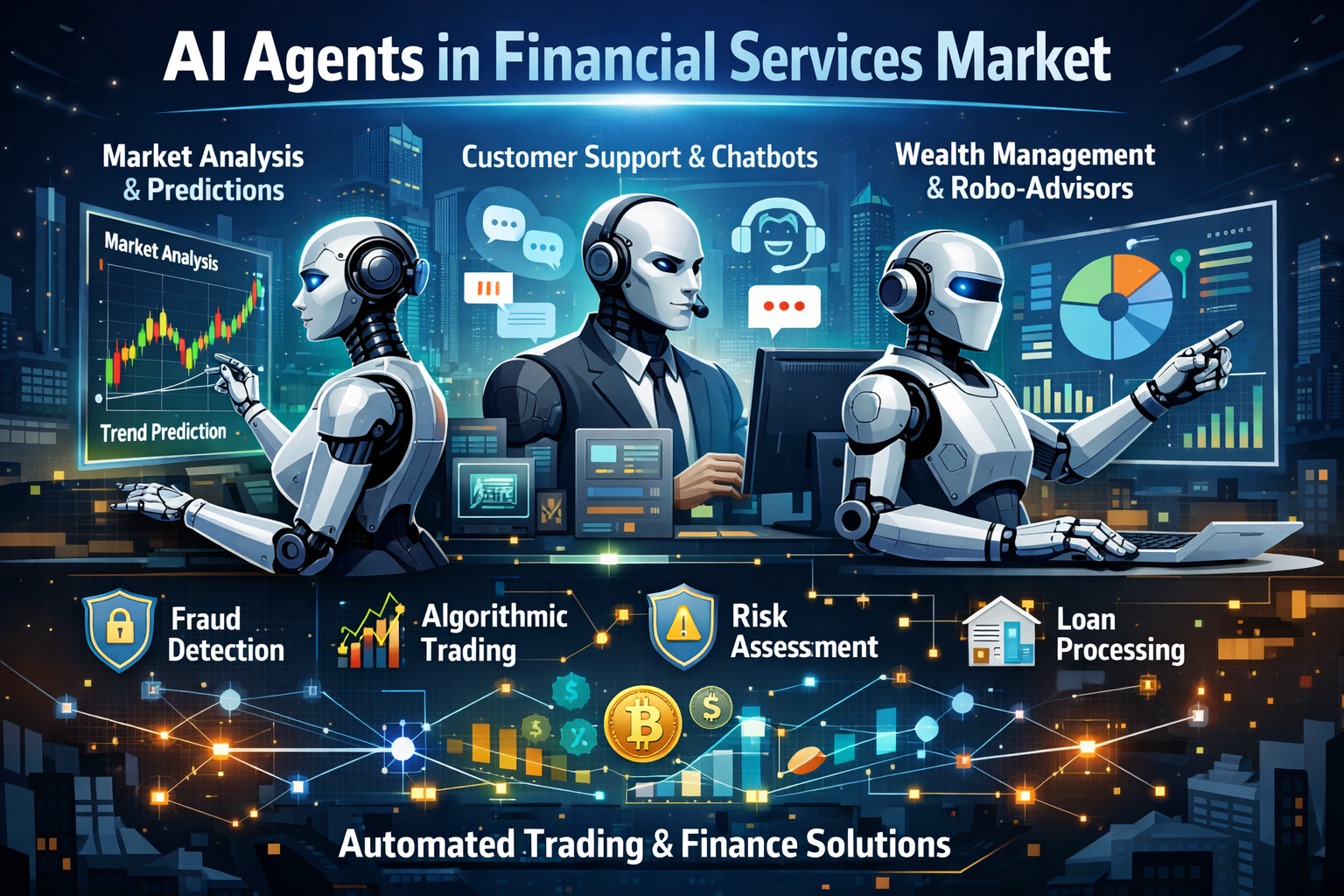
Key Highlights
- Significant ROI: Banks are achieving a 2.3x return on Agentic AI investments within approximately 13 months.
- Market Growth: The AI agents in financial services market is set to hit USD 6.7 billion by 2033, driven by a 31.5% CAGR.
- Autonomous vs. Traditional: Unlike RPA, Agentic AI handles unstructured data and adapts to changing workflows without manual reprogramming.
- Fraud Mastery: AI agents are now the gold standard for detecting synthetic identity fraud and reducing costly false positives.
- Efficiency Gains: Leading institutions are seeing up to 70% cost reductions in specific operational categories like onboarding and compliance.
What if banking infrastructure didn’t just follow instructions, but actually understood the business goals and acted independently to achieve them? In the rapidly shifting landscape of 2026, the global financial sector is moving beyond the era of static “if-then” logic. The emergence of Agentic AI in banking is fundamentally rewriting the playbook for operational efficiency, shifting the focus from simple task automation to autonomous, goal-oriented execution.
For years, banks relied on Robotic Process Automation (RPA) to handle repetitive data entry. While effective, these systems were fragile, breaking the moment a form changed or an unexpected variable appeared. Agentic AI, powered by sophisticated large language models and autonomous reasoning loops, represents a paradigm shift. These “agents” can plan, reason, and adapt in real-time, offering a level of flexibility that traditional automation never could.
The State of the Market: 2026 Trends
The financial appetite for agentic systems is no longer speculative. According to recent market analysis, the global AI agents in financial services market is projected to reach USD 6.7 billion in 2033, growing at a staggering CAGR of over 31.5%.
Several key trends are driving this explosive adoption:
- From Copilots to Agents: Banks are moving from “human-in-the-loop” assistants (Copilots) to “human-on-the-loop” agents that manage end-to-end workflows. In a landmark move, in February 2026, Goldman Sachs collaborated with AI safety firm Anthropic to deploy “Claude-based” autonomous agents. These agents are specifically designed for trade and transaction accounting and client due diligence.
- The Rise of Multi-Agent Systems (MAS): Institutions are deploying “fleets” of specialized agents, one for credit scoring, one for fraud detection, and a supervisory agent to orchestrate the final decision. On April 08, 2026, Citi recently announced the successful automation of 50 core processes. Most notably, they utilized Agentic AI to reduce document review times for account openings from 75 minutes to just 15 minutes.
- Regulatory-First Automation: With 2026 seeing stricter global compliance standards, agentic systems are being utilized to navigate the complexities of real-time Anti-Money Laundering (AML) and Know Your Customer (KYC) protocols. Firms like Deloitte have launched pre-built “Regulatory Reporting Agents” that autonomously monitor global policy shifts and update internal compliance workflows in real-time.
Maximizing ROI: The Financial Logic
The primary question for C-suite executives is no longer “Does it work?” but “How fast does it pay for itself?” In 2026, the data is clear: organizations are seeing an average 2.3x return on investment within the first 13 months of deploying agentic systems. On February 11, 2026, in a USD 25.1 billion deal, Palo Alto Networks acquired CyberArk to create an end-to-end security platform specifically tailored for AI. This is critical for banks that require “Identity-First” security to ensure that autonomous agents have the correct permissions without creating new vulnerabilities.
1. Slashing Operational Overhead
Traditional automation typically plateaus at a 20% efficiency gain. In contrast, Agentic AI can reduce certain operational cost categories by as much as 70%. By handling unstructured data, such as messy emails, handwritten documents, or complex regulatory filings, agents eliminate the “exception handling” that previously required expensive human intervention. On March 18, 2026, Deloitte launched Zora AI, an autonomous agentic platform built on NVIDIA. It automates complex finance, HR, and supply chain tasks, aiming to boost productivity by 40% and slash operational costs.
2. Accelerating Time-to-Revenue
In wealth management and corporate lending, “time is money” is a literal constraint. Agentic AI can reduce customer onboarding cycles by 50% and cut the time advisors spend on manual prospecting by nearly half. By accelerating the transition from “prospect” to “funded account,” banks can realize revenue significantly faster, directly boosting the bottom line.
3. Enhancing Fraud Prevention and Compliance
Unlike traditional systems that flag transactions based on rigid rules, AI agents analyze behavioral patterns in real-time. This reduces “false positives”, which cost banks billions in lost transactions and customer friction, while identifying sophisticated deepfake and synthetic identity fraud that standard systems miss.
Overcoming the Implementation Gap
Despite the clear financial benefits, a “readiness gap” remains. While nearly all major banks plan to deploy agents, only a fraction have achieved full-scale production. The primary hurdles are data readiness and governance. Agentic AI requires a unified, real-time data foundation to function effectively. Banks that continue to operate in data silos find their agents “hallucinating” or making sub-optimal decisions.
Furthermore, the shift to agentic systems requires a new set of Key Performance Indicators (KPIs). Instead of measuring “uptime,” forward-thinking banks are tracking:
- Autonomous Task Completion Rate: The percentage of workflows finished without human intervention.
- Human Escalation Rate: How often the agent correctly identifies an “edge case” and hands it off.
- Cost Per Interaction: A direct metric comparing the expense of an agent versus a human-led process.
The Road Ahead The future of banking is not just automated; it is autonomous. As we move further into 2026, the competitive divide will widen between institutions using “dumb” scripts and those utilizing “smart” agents. AI agents in financial services are the key to unlocking the next level of profitability, transforming the back office from a cost center into a high-speed engine for growth. By focusing on disciplined use-case selection and robust governance, financial institutions can turn the promise of AI into a tangible, high-yield dividend.