




Key Highlights
- The AI voice generator market is rapidly expanding due to increasing demand for scalable audio content.
- AI voice technology enables cost-efficient and high-quality voice generation across industries.
- According to Grand View Research, the global AI voice generator market is projected to reach USD 21,754.8 million by 2030.
- The AI voice generator market is driven by the creator economy, multilingual capabilities, and enterprise adoption.
- Ethical concerns, such as voice cloning and deepfakes, remain key challenges.
What if the next voice you hear online is not human, but you cannot tell the difference? That’s exactly where the AI voice generator market is heading. From YouTube narrations to customer support calls and audiobooks, synthetic voices are rapidly becoming indistinguishable from real human speech.
The AI voice generator industry is witnessing strong momentum as businesses and creators increasingly adopt AI-powered voice tools to scale content, reduce production costs, and deliver personalized experiences. With the rise of generative AI, voice technology has evolved from robotic outputs to highly expressive, human-like communication.
Moreover, as digital consumption continues to surge, the demand for faster and more scalable content production is growing. According to Grand View Research, the global AI voice generator market is projected to reach USD 21,754.8 million by 2030, highlighting the strong growth trajectory of the industry. This shift is pushing the technology from experimental use cases to mainstream adoption across industries such as media, gaming, education, and customer service.
What is an AI Voice Generator? A Simple Explanation
An AI voice generator is a software tool that converts written text into natural-sounding speech using artificial intelligence and deep learning models. Unlike traditional text-to-speech systems, which often sound mechanical, modern AI voice generators are designed to replicate human speech patterns, including tone, pitch, pauses, and even emotions.
These tools work by analyzing vast datasets of recorded human voices and learning how speech is structured. As a result, they can produce highly realistic audio outputs that closely resemble real human voices. This makes them ideal for applications where natural communication is essential, such as virtual assistants, voiceovers, and automated customer interactions.
Today, AI voice generators are being widely adopted across industries. Whether it is a YouTube creator generating narration, a company automating its call center, or an e-learning platform producing audio lessons, the AI voice generator market is enabling faster, scalable, and cost-effective voice production.
How AI Voice Generation Works: Technologies Behind Natural-Sounding Voices
At its core, AI voice generation is powered by neural networks, natural language processing, and advanced speech synthesis technologies. These systems break down written text into phonemes, the smallest units of sound, and then reconstruct them into fluid, human-like speech.
In addition, deep learning models are trained to understand context, sentence structure, and emotional cues. This allows AI voices to sound more conversational rather than robotic. Over time, as these models are exposed to more data, their ability to replicate human speech continues to improve significantly.
Multilingual AI Voices: Breaking Language Barriers Globally
Building on these underlying technologies, multilingual AI voice systems extend these capabilities across different languages, enabling seamless global communication.
- Enables brands to localize content without separate voice recordings.
- Supports multiple languages while maintaining a consistent voice identity.
- Preserves accent and pronunciation accuracy using localized datasets.
- Reduces the time and cost of producing multilingual content.
- Expands global audience reach for businesses and creators.
As a result, companies can now create one piece of content and distribute it worldwide with localized voiceovers, making communication more inclusive and scalable.
AI Voice Generators Are Disrupting the Voice Acting Industry
The growing adoption of AI voice tools is significantly impacting the traditional voice acting industry. While voice actors have long been essential for delivering emotional and engaging performances, AI voice generators are introducing a new level of efficiency and scalability.
For example, businesses can now generate multiple voice variations within minutes, which would otherwise take hours or even days with human actors. This is particularly beneficial for industries like advertising, gaming, and e-learning, where high-volume content production is required.
However, this shift does not necessarily replace human talent. Instead, it is reshaping how voice work is approached, with many companies adopting a hybrid model that combines AI efficiency with human creativity.

AI Voice Generators vs Human Voice Artists: A Complete Comparison
While both AI-generated voices and human artists serve the same purpose, their capabilities differ in several important ways. As the AI voice generator market continues to evolve, businesses are increasingly evaluating which option best fits their content strategy and production needs.
In many cases, the decision is influenced by scalability requirements, cost constraints, turnaround time, and the need for emotional storytelling. Therefore, a clear comparison helps organizations align their voice strategy with their business objectives.
| Parameter | AI Voice Generators | Human Voice Artists |
|---|---|---|
| Cost Efficiency | Low cost, scalable for bulk content | High cost per project |
| Production Speed | Instant voice generation | Time-intensive recording process |
| Flexibility & Editing | Easy to edit and regenerate instantly | Requires re-recording for changes |
| Emotional Depth | Improving, but still limited in nuance | High emotional intelligence and expression |
| Scalability | Highly scalable across projects | Limited by availability and workload |
| Consistency | Consistent tone across outputs | May vary between recordings |
AI voice generators are ideal for high-volume, scalable content production. Human voice artists remain essential for emotionally driven and storytelling content. As a result, many organizations are adopting a hybrid model to balance efficiency with authenticity.
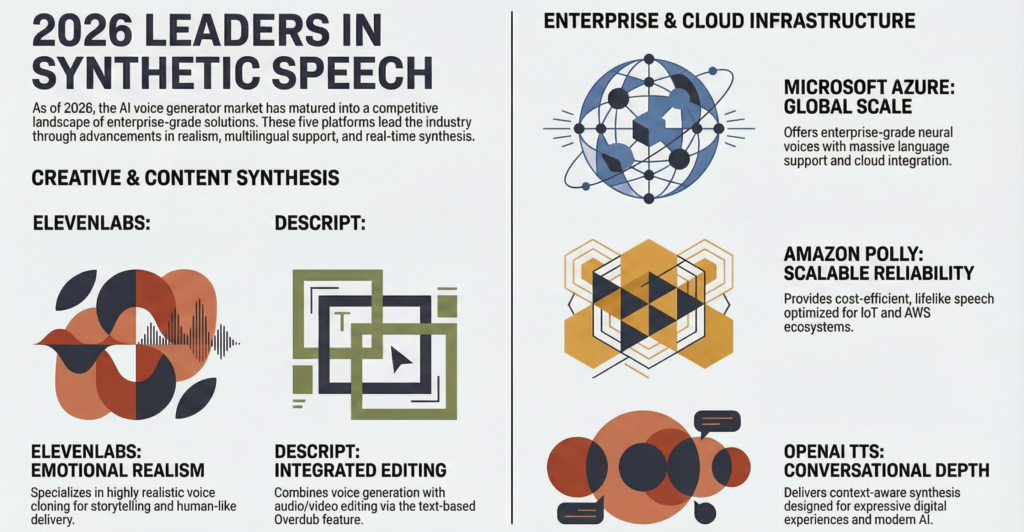
Top 5 AI Voice Generators: Leading Platforms Powering the Market in 2026
The AI voice generator market has become highly competitive, with major technology companies and innovative platforms offering advanced voice synthesis capabilities. These tools are not only improving in realism but also expanding into enterprise-grade solutions with APIs, multilingual support, and real-time voice generation.
- ElevenLabs: Known for its highly realistic voice cloning and emotional depth, it is widely used for storytelling, audiobooks, and content creation. The platform enables users to generate expressive voices that closely mimic human tone and delivery.
- Microsoft Azure Speech Services: Offers enterprise-grade text-to-speech solutions with strong integration capabilities across applications and cloud platforms. It supports a wide range of languages and provides neural voices for highly natural output.
- Amazon Polly: A scalable cloud-based service that converts text into lifelike speech for applications, websites, and IoT devices. It is widely adopted by enterprises due to its reliability, cost-efficiency, and seamless AWS integration.
- Descript: Combines voice generation with audio and video editing, making it popular among creators and podcasters. Its Overdub feature lets users create voice clones and edit audio content with simple text edits.
- OpenAI TTS: Provides advanced AI-generated voices with high-quality natural speech output, suitable for applications and conversational AI. It focuses on delivering expressive and context-aware voice synthesis for modern digital experiences.
AI Voice in the Creator Economy: YouTube, Podcasts & Audiobooks
The rise of the creator economy has played a crucial role in accelerating the AI voice generator market. Content creators are constantly looking for ways to produce high-quality content faster, and AI voice tools provide an efficient solution.
For instance, YouTubers can generate voiceovers without recording audio, while podcasters can produce episodes more consistently. Similarly, audiobook creators can convert written content into narrated formats in a fraction of the time and cost.
As a result, AI voice technology is lowering entry barriers for creators and enabling them to scale their content production. This democratization of content creation is one of the key factors driving market growth.
The Ethics & Safety of AI Voice Generation: What You Need to Know
While the benefits of AI voice technology are substantial, ethical and safety concerns cannot be ignored. The ability to replicate human voices raises serious questions about misuse, particularly in cases of impersonation and deepfake audio. Copyright, consent, and regulatory concerns are becoming central to the discussion.
Using someone’s voice without permission can lead to legal and ethical issues, while the lack of clear ownership rights over synthetic voices adds further complexity. Governments and organizations are gradually introducing guidelines to address these challenges.
- Risk of unauthorized voice cloning and identity misuse.
- Growing concerns around deepfake audio and misinformation.
- Lack of standardized global regulations.
- Increasing need for authentication and watermarking technologies.
Addressing these challenges will be critical to ensuring the sustainable growth of the AI voice generator market.
What’s Next
The AI voice generator market is expected to witness rapid advancements in emotional intelligence, real-time voice interaction, and context-aware speech capabilities, making AI voices increasingly human-like. Businesses are likely to adopt AI voice solutions at scale to automate communication while maintaining a high level of personalization. At the same time, multilingual capabilities will further improve, enabling brands to connect with global audiences more effectively.
However, growing adoption will also accelerate the need for strong regulatory frameworks and ethical guidelines. As a result, trust, transparency, and responsible AI usage will become critical success factors. Ultimately, the future of the AI voice generator industry will be defined by a balance between innovation and accountability.