


- Flat Medical’s Mercury safety syringe effectively shields needles, reducing healthcare worker injuries by 80% this year.
- WHO’s 2026 mandates make traditional syringes obsolete, prioritizing auto-disable technology to prevent millions of infections.
- KNUST’s AI-driven pumps and Schreiner’s NFC-tracked boxes are turning simple injections into high-precision, data-rich procedures.
In the rapidly evolving landscape of medical technology, few innovations have promised as much immediate impact as the smart syringe. As we navigate the complexities of global health in 2026, the shift from traditional delivery methods to intelligent systems is no longer a luxury but a clinical necessity. The global smart syringes market, which is estimated at approximately 1.05 billion as of 2025, is currently experiencing a massive surge driven by 8.7% CAGR as healthcare systems prioritize safety and data-driven care.
From the frontline of hospital wards to the logistics of international immunization programs, the following four pillars are defining the current state of the smart syringe revolution.
The End of the Needle-Stick Injury: How Smart Syringes are Saving Healthcare Workers’ Lives
For decades, needle-stick injuries (NSIs) have been the silent epidemic of the healthcare industry. Beyond the physical pain, the risk of contracting blood-borne pathogens such as HIV or Hepatitis B makes this a critical safety failure. Smart syringes are effectively ending this era through Active and Passive Safety Mechanisms.
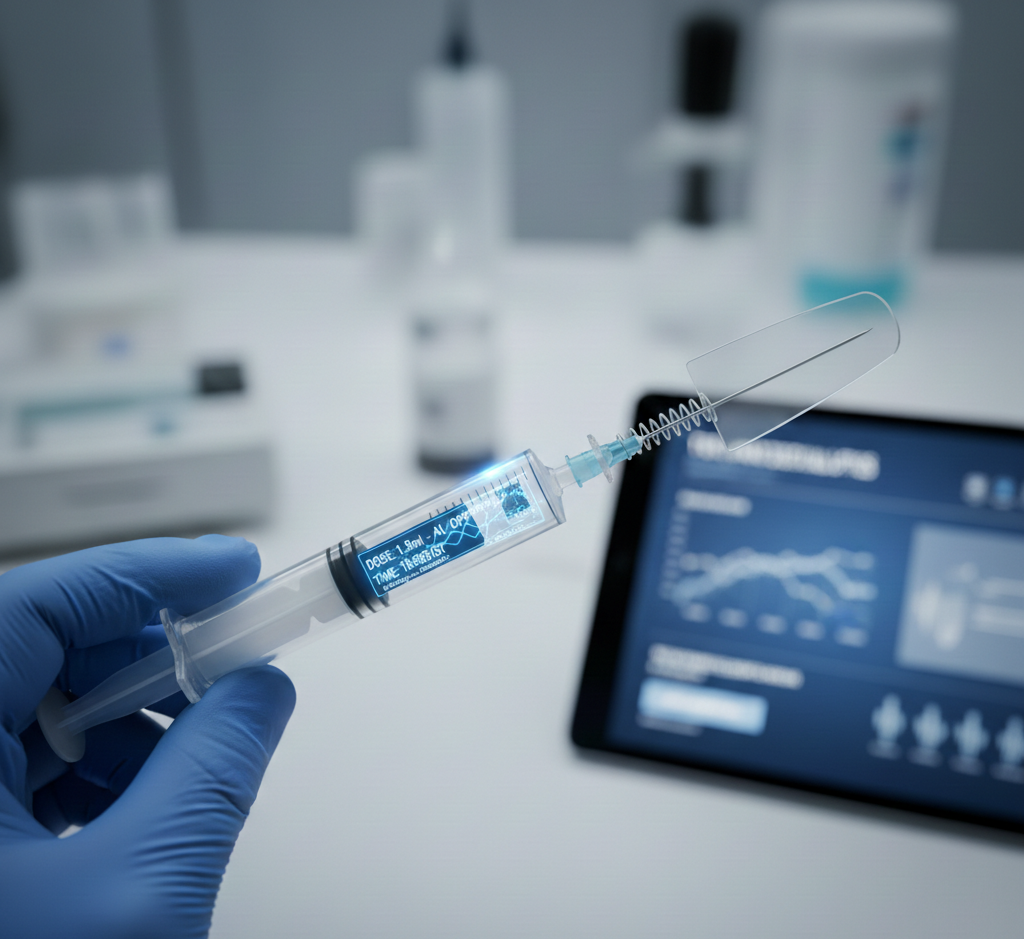
A major breakthrough in this space is the Mercury safety syringe by Flat Medical. Unlike traditional designs, this system features a unique safety-locking mechanism that ensures the needle is shielded immediately after use. Strategic distribution partnerships, such as Flat Medical’s recent expansion into the U.S. market are making these devices the standard in high-stakes environments such as anesthesiology and emergency medicine. By eliminating the need for manual recapping, these modern syringes have reduced NSI rates in some hospital systems by over 80% this year.
WHO Guidelines 2026: Why Traditional Syringes are Becoming Obsolete in Public Health
The World Health Organization (WHO) has long campaigned for a global transition to safety-engineered devices. Building on their landmark call for worldwide ‘smart’ syringe adoption to prevent the 1.7 million people annually infected with Hepatitis B, the 2026 Operational Guide has set a firm line: traditional syringes are being phased out.
The primary driver is the mandate for Auto-Disable (AD) technology. These syringes are designed to lock or break the internal mechanism after a single use, making it physically impossible to reuse the device a practice that previously caused millions of cross-infections. In the 2026 vaccine landscape, where zero-reuse is the gold standard, traditional syringes are becoming obsolete because they cannot compete with the safety guarantees of smart tech. In developing regions, this transition is the cornerstone of the goal to eliminate viral hepatitis as a public health threat.
The Green Syringe: Can We Make Life-Saving Tech Eco-Friendly?
One of the greatest paradoxes in medicine is that saving a life often generates significant plastic waste. However, ‘smart’ does not just mean digital; it means efficient. In 2026, we are seeing the rise of the sustainable smart syringe ecosystem.
Innovation is happening at the packaging level with solutions such as Schreiner MediPharm’s Smart Syringe Box. By integrating NFC (Near Field Communication) technology into the packaging, manufacturers can track the entire lifecycle of a syringe. This ensures better inventory management, reducing the number of expired, wasted syringes that end up in landfills. Furthermore, by moving toward ‘Reduced Dead-Space’ designs, these syringes ensure that every drop of expensive medication is utilized, minimizing hazardous chemical waste per injection. The goal is no longer just to save the patient, but to do so without harming the planet.
Smart Syringes Meet AI: The Future of Personalized Dosing
The most futuristic leap in this market is the integration of Artificial Intelligence and IoT connectivity. We are moving away from simple manual injections toward automated, precision systems.
A prime example of this is the recent breakthrough by students at KNUST (Kwame Nkrumah University of Science and Technology), who developed a Smart Syringe Pump. This AI-ready device is designed to manage fluids and medications during surgery with extreme precision, automatically adjusting flow rates to prevent human error. When combined with Bluetooth-enabled syringes that sync with smartphone apps, the result is a ‘closed-loop’ system:
Precision Tracking: AI algorithms analyze injection timing and dosage accuracy.
Personalized Adjustments: For chronic conditions, real-time data from a smart syringe can be synced with a patient’s wearable monitor, allowing the AI to suggest the optimized dosage for the next injection.
The smart syringe is no longer a concept of the future, it is the standard of the present. Whether it is a safety syringe from Flat Medical protecting a doctor, or an AI-driven pump from KNUST innovators ensuring surgical precision, these devices are fundamentally reshaping care. The transition from ‘plastic and steel’ to ‘connected and protected’ is the most significant leap in drug delivery of our generation.