



Key Highlights
- Thai flooding disrupted natural rubber tapping and tightened physical supply.
- Natural rubber price spikes encouraged substitution toward BR and SBR.
- Weak automotive and tire demand limited the duration of price rallies.
- NBR followed a more stable pricing path due to its specialized applications.
- El Niño risks and seasonal wintering could influence early-2027 supply expectations.
In this article
The Forces Behind an Unpredictable Rubber Market
Thai Flooding Exposes Natural Rubber Supply Vulnerability
Natural Rubber’s Rally Changes Synthetic Rubber Economics
Weak Tire Demand Limits the Upside
Why NBR Follows a Different Market Path
El Niño Adds Another Layer of Supply Uncertainty
The Forces Behind an Unpredictable Rubber Market
Rubber is essential to automotive tires, medical gloves, industrial seals, fuel hoses, and numerous manufacturing applications. Yet its pricing is shaped by a complex interaction of agricultural supply, weather conditions, chemical feedstocks, freight costs, and downstream demand.
Recent market movements illustrate how quickly these factors can change the economics of natural and synthetic rubber. Severe rainfall in Thailand restricted tapping activity, while falling inventories in China added to supply concerns. At the same time, tire manufacturers adjusted material formulations as natural rubber became more expensive.
For procurement teams, understanding these connections is critical. Rubber pricing intelligence helps businesses move beyond isolated price observations and assess the supply, demand, and cost factors that influence purchasing decisions.
1. Thai Flooding Exposes Natural Rubber Supply Vulnerability
Thailand’s position as a leading natural rubber producer makes its weather conditions particularly important to global supply. Heavy rainfall and flooding interrupted tree-tapping operations and created localized transportation bottlenecks, restricting the movement of raw materials.
These disruptions coincided with declining inventories at major storage hubs such as Qingdao, China. Supply concerns contributed to a rapid increase in natural rubber futures, which rose nearly 1.9% during the first nine days of October to their highest levels since early 2013. China’s RSS3 natural rubber prices recorded average month-on-month growth of 6.0%.
India also experienced tight availability, with Kerala RSS-4 reaching a record high. However, as Thai weather conditions improved and traders anticipated a seasonal recovery in tapping, futures retreated approximately 3.4%.
This sequence demonstrates how weather-related supply shocks can trigger rapid price increases, while expectations of production recovery can quickly change market sentiment.
2. Natural Rubber’s Rally Changes Synthetic Rubber Economics
Natural rubber price increases can influence synthetic rubber markets even when their own feedstock costs are declining. This relationship became visible in China, where butadiene prices fell approximately 3%, yet Butadiene Rubber (BR) increased 6.0% and Styrene Butadiene Rubber (SBR) rose 5.1%.
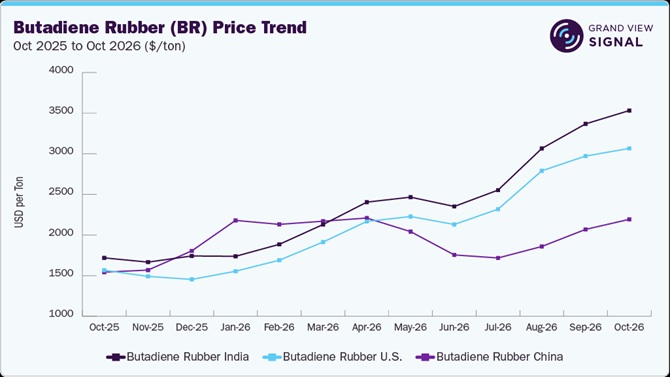
Get Full Access to Price Trends & Market Drivers.
The explanation lies in material substitution. Faced with higher natural rubber costs, tire manufacturers adjusted formulations where technical requirements allowed them to use more synthetic alternatives. The resulting demand strengthened BR and SBR pricing power, allowing producers to improve margins despite lower input costs.
The impact extended beyond China. Saudi Arabia and the UAE experienced synthetic rubber price increases of up to 6.0%, with elevated export prices compounded by freight and war-risk insurance expenses. In Egypt and Morocco, stronger international prices and currency depreciation increased the landed cost of imported rubber.
For buyers, monitoring natural and synthetic grades together is therefore essential. A movement in one material can alter demand and pricing conditions in another.
3. Weak Tire Demand Limits the Upside
Supply disruptions supported rubber prices, but downstream demand remained an important constraint. Tire manufacturers faced pressure from weak order volumes and operating margins, encouraging cautious purchasing rather than aggressive inventory building.
Industry reports cited in the source indicated that North American passenger car replacement tire demand declined 3% over nine months, while European demand contracted 1%. Original Equipment tire demand also remained weak globally, although China showed relative strength in replacement tires.
Chinese processing plants entered seasonal holidays with subdued orders, and some temporarily suspended operations to limit losses. Across markets, manufacturers increasingly followed hand-to-mouth procurement strategies, purchasing only the volumes required for immediate production.
This explains why a supply-driven rally may not become a sustained upward cycle. When supply conditions improve, limited buying interest can accelerate price corrections.
4. Why NBR Follows a Different Market Path
Acrylonitrile Butadiene Rubber (NBR) does not share the same demand profile as tire-focused BR and SBR. Its applications include oil-resistant seals, automotive gaskets, industrial fuel hoses, and medical disposable gloves.
Because tire manufacturers are not its primary demand driver, NBR received limited benefit from the substitution trend. Feedstock conditions also offered little upward cost pressure: Chinese acrylonitrile prices remained broadly unchanged, while butadiene costs declined.
NBR prices increased only 2.2% in China, while European assessments rose 1.1% and U.S. prices gained 3.1%. These comparatively modest movements highlight why procurement teams should evaluate rubber grades individually instead of assuming that all synthetic materials follow the same market direction.
5. El Niño Adds Another Layer of Supply Uncertainty
Looking beyond immediate weather disruptions, El Niño conditions present a potential risk to Southeast Asian rubber production. The source highlights the possibility of intensifying conditions extending into early 2027.
Drier weather can reduce latex yields, particularly when it coincides with the seasonal wintering period, when rubber trees shed leaves and tapping activity naturally declines. This creates uncertainty around first-quarter supply availability.
Consequently, improving weather in Thailand does not automatically remove the market’s supply concerns. Buyers remain cautious about assuming that lower prices will persist when future yields are exposed to climatic and seasonal risks.
Turning Rubber Market Signals into Sourcing Decisions
Manufacturers and procurement teams need to monitor more than headline prices. Comparing natural and synthetic rubber benchmarks, tracking butadiene and styrene costs, evaluating regional freight expenses, and assessing automotive demand can provide a clearer view of purchasing exposure.
Grand View Signal supports this process through real-time price benchmarking, granular Average Selling Price (ASP) metrics, historical datasets covering a ten-year window, predictive forecasting, and integrated risk and scenario analytics. Its coverage spans more than 200 raw material commodities and major geographic markets.
These capabilities help sourcing teams assess price cycles, identify emerging disruptions, and evaluate supplier negotiations using a broader market context. In a market influenced by weather, substitution, and uneven manufacturing demand, informed procurement depends on connecting these signals rather than viewing them in isolation.
Frequently Asked Questions
1. What are the main factors influencing global rubber prices?
Weather disruptions, natural rubber availability, synthetic rubber feedstock costs, automotive demand, freight expenses, and regional currency movements are key influences.
2. How does Thai rainfall affect natural rubber prices?
Heavy rainfall and flooding can interrupt tree tapping and transportation, reducing available supply and increasing market concerns about raw material availability.
3. Why can synthetic rubber prices rise when feedstock costs fall?
When natural rubber becomes expensive, tire manufacturers may substitute synthetic grades such as BR and SBR where specifications permit. Increased demand can support synthetic rubber prices even if feedstock costs decline.
4. Why does NBR behave differently from BR and SBR?
NBR is used primarily in specialized applications such as industrial seals, fuel hoses, gaskets, and medical gloves. It is therefore less directly affected by tire manufacturers’ substitution decisions.
5. How can rubber pricing intelligence help procurement teams?
It helps businesses benchmark prices, understand historical cycles, monitor regional supply risks, assess feedstock movements, and use forecasting and scenario analysis to support sourcing decisions.