

Key Takeaways:
- According to Grand View Research, the global lithium-ion battery market is projected to reach USD 306.24 billion by 2033.
- From high-altitude salt deserts to ancient hardrock deposits, lithium harvesting leaves a lasting mark on land, water, and people.
- Several long-held assumptions about battery toxicity, manufacturing emissions, and recyclability don’t hold up under scrutiny.
- Breakthroughs in battery chemistry, smarter extraction methods, and second-use frameworks are rewriting the sustainability story.
- Building a cleaner energy future demands honest accountability, not just from manufacturers, but from every stakeholder in the battery value chain.
Picture a world where every car runs silently on electricity, where rooftop solar panels store sunshine for cloudy days, and where portable devices never need a wall outlet for weeks on end. This is the world lithium-ion batteries are building, one charge cycle at a time. The technology has moved from niche novelty to civilizational infrastructure with breathtaking speed, and the momentum shows no signs of slowing.
Yet as the demand for battery-powered everything accelerates, a more inconvenient narrative is struggling to break through. According to Grand View Research, the global lithium-ion battery market is projected to reach USD 306.24 billion by 2033, a figure that reflects not just commercial appetite but the sheer scale of raw material demand that must be met to get there.
Manufacturing facilities, supply chains, and mining operations are all expanding rapidly. The ecological systems, water sources, and communities caught in the path of that expansion deserve far more scrutiny than they currently receive.
Lithium-Ion Technology and the Ecology of Making It
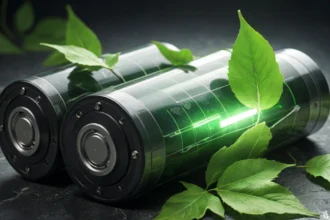
At their core, lithium-ion batteries are elegant machines, lightweight, rechargeable, and capable of storing extraordinary amounts of energy relative to their size. This fundamental efficiency is a key reason the lithium-ion battery market has witnessed rapid expansion across industries, from consumer electronics to electric vehicles.
The underlying chemistry involves lithium ions shuttling back and forth between electrodes during charging and discharging, releasing electrical energy in a controlled and highly efficient manner. This simplicity of function, however, masks a deeply complex and resource-intensive production process.
Long before a battery reaches a showroom floor or a power grid, it passes through a chain of industrial processes that carry a measurable ecological toll, an often overlooked reality within the broader lithium-ion battery industry. Ore must be blasted from mountainsides or pumped from underground aquifers.
Metals must be refined, purified, and synthesized into electrode materials. Cell assembly itself demands precision manufacturing under tightly controlled conditions. Each of these steps draws on energy, water, and chemical inputs, and each leaves a trace on the environment that the finished product, however clean in operation, cannot fully erase.
Tracing the Ecological Footprint: Where Does the Damage Begin?
The environmental reckoning with lithium-ion batteries does not begin in the recycling bin; it begins at the source. As demand continues to surge across the lithium-ion battery market, the pressure on upstream resource extraction has intensified significantly. Two dominant methods of lithium recovery account for the majority of global supply, and both carry consequences that the industry has been slow to publicly quantify.
- Lithium sourcing: the core challenge: At the heart of every lithium-ion battery is a finite, geographically concentrated resource that must be extracted under conditions that frequently conflict with environmental and social safeguards. The pressure to scale extraction rapidly to meet surging demand has, in many cases, outpaced the regulatory and technological frameworks needed to manage it responsibly.
- Brine evaporation from salt flats: In South America’s high-altitude desert ecosystems of the Lithium Triangle, vast quantities of mineral-rich groundwater are drawn to the surface and left to evaporate across sprawling pond systems. The process is relatively low in direct energy consumption but extraordinarily water-intensive, the very resource that sustains fragile desert wetlands, endemic flamingo colonies, and the agricultural livelihoods of indigenous Andean communities. Once depleted, these aquifers recover on timescales measured in decades, not years.
- Hard-rock excavation at scale: In mineral-rich regions across Australia, Canada, and southern Africa, lithium-bearing spodumene ore is extracted through large-scale open-cut mining. This extraction pathway plays a critical role in supporting supply chains across the broader lithium-ion battery industry, yet the environmental costs are substantial. The visual transformation of the landscape is immediate and extensive, ridgelines become quarry walls, valleys fill with spoil heaps, and drainage patterns shift. Additionally, the chemical inputs required to process raw ore into battery-grade material introduce contamination risks that require continuous monitoring and management.
The Ripple Effects: Lithium-Ion Battery Market Impact on Ecosystems
The consequences of lithium extraction extend far beyond the boundaries of a mine or brine field. They ripple outward through water systems and soil structures, and into the everyday lives of communities that may never directly use a lithium-ion battery.
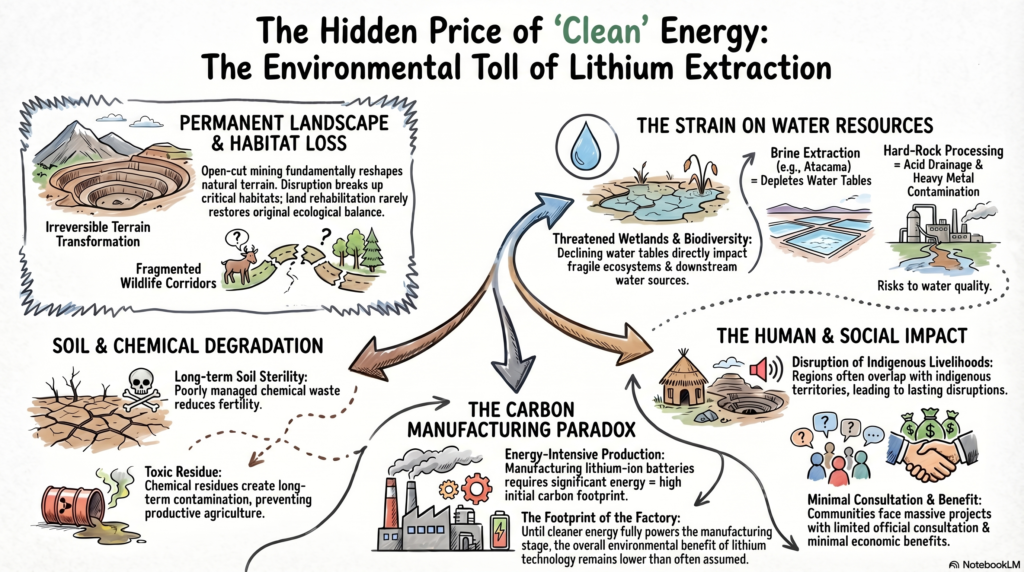
- Permanent Landscape and Habitat Disruption: Open-cut mining fundamentally reshapes natural terrain. Ancient landforms are carved away, vegetation that took centuries to evolve is lost, and critical wildlife corridors are fragmented. While land rehabilitation is often promised, it rarely fully restores the original ecological balance.
- Strain on Freshwater Resources: Lithium extraction places immense pressure on already fragile water systems. In regions like the Atacama, brine extraction has been linked to declining water tables, threatening wetlands and biodiversity. Meanwhile, hard-rock processing carries risks of acid drainage and heavy metal contamination affecting downstream water sources.
- Soil Degradation and Chemical Residue: Poorly managed chemical waste from extraction and processing can lead to long-term soil contamination. These pollutants reduce soil fertility, disrupt microbial ecosystems, and can leave once-productive land unusable for years.
- Impact on Indigenous and Local Communities: Lithium-rich regions often overlap with indigenous territories. Many communities face extraction projects with limited consultation, minimal economic benefits, and lasting disruptions to environmental, cultural, and traditional livelihoods.
- Hidden Carbon Cost of Manufacturing: While lithium-ion batteries enable low-emission technologies, their production is energy-intensive. Significant carbon emissions occur during manufacturing, and until cleaner energy fully powers this stage, the overall environmental footprint remains higher than often assumed.
Clearing the Air: Rethinking Common Myths About Lithium-Ion Batteries
Misinformation around lithium-ion batteries flows in both directions; some narratives downplay their environmental impact, while others exaggerate it. As the lithium-ion battery market continues to expand, separating fact from assumption becomes increasingly important.
Belief 1: Lithium Batteries Are Inherently Toxic
The idea that lithium-ion batteries are highly toxic is often overstated. Lithium itself is far less hazardous than heavy metals like lead or mercury used in older battery chemistries. The real concerns lie with materials such as cobalt and nickel, particularly during mining, processing, and improper disposal. The risk is not from everyday use but from how these materials are sourced and managed across the lithium-ion battery industry.
Belief 2: Battery Production Cancels Out Climate Benefits
Battery manufacturing does carry a carbon footprint, especially for electric vehicles. However, this “carbon debt” is temporary. Over time, emissions saved during operation, especially as power grids shift toward renewables, more than offset the initial impact. The long-term climate advantage remains firmly in favor of battery-powered technologies.
Belief 3: Lithium-Ion Batteries Cannot Be Recycled
Recycling technology has advanced significantly. Modern processes can recover valuable materials such as lithium, cobalt, and nickel at near-battery-grade quality. While large-scale recycling infrastructure is still developing, the challenge today is less about technology and more about efficient collection systems, cost structures, and scaling global capacity.
The Honest Balance Sheet: Where Lithium-Ion Batteries Deliver Real Impact
A balanced view of lithium-ion batteries must recognize what they are already achieving at scale. As the lithium-ion battery market expands, these technologies are playing a central role in reducing dependence on fossil fuels.
Electrification of transport, across personal vehicles, public transit, and commercial fleets, has become one of the most effective pathways to cut emissions. At the same time, battery storage is enabling renewable energy to integrate more reliably into power grids, reducing reliance on carbon-intensive backup systems.
Encouragingly, progress is not static. In the lithium-ion battery industry, manufacturers are actively improving material efficiency and sustainability. Cobalt usage has declined in newer chemistries, water-efficient extraction methods are gaining traction, and companies are increasingly disclosing lifecycle emissions while committing to responsible sourcing.
These advancements do not eliminate the environmental challenges, but they signal a clear shift toward greater accountability and long-term sustainability.
What Lies Ahead: Innovation Shaping a Cleaner Battery Future
Across research labs, engineering hubs, and policy circles, a wave of innovation is redefining how batteries are designed, produced, and reused. As the lithium-ion battery market continues to evolve, these emerging solutions have the potential to significantly reduce environmental impact over the next decade.
- Solid-State Batteries: Replace liquid electrolytes with solid materials, improving safety, increasing energy density, and reducing reliance on cobalt.
- Lithium Iron Phosphate (LFP) Chemistry: Offers longer lifespan, improved thermal stability, and eliminates the need for cobalt and nickel, making it a more sustainable alternative.
- Sodium-Ion Batteries: Utilize abundant raw materials to address resource scarcity concerns for applications where cost and scalability matter more than energy density.
- Advanced Brine Extraction: New techniques, such as selective membranes and electrochemical recovery, reduce water use compared to traditional evaporation methods.
- Closed-Loop Recycling Systems: Enable recovered materials to be reused directly in new batteries, reducing reliance on virgin mining inputs across the lithium-ion battery industry.
- Smart Battery Management Systems: Use real-time data to optimize performance, extend battery life, and delay the need for replacement and recycling.
Where the Story Goes From Here
The future of the lithium-ion battery market depends not just on growth, but on how responsibly it evolves. While batteries are essential for a low-carbon future, their sourcing and production still need improvement, especially for affected communities and ecosystems. As demand rises, so do both the risks and the opportunities for better recycling, innovation, and accountability. The path forward is clear; the challenge is keeping progress aligned with the pace of growth.
Continue Reading: