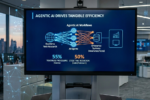



Key Highlights:
- Genpact and Parallel partnered on April 8, 2026. This move integrates AI-native agents into enterprise workflows.
- This collaboration gives autonomous agents real-time web intelligence and context.
- Notably, early results delivered 55% touchless processing for insurance claims. In addition, sales cycle times dropped by 50% for users.
NEW YORK and PALO ALTO, Calif. — Genpact and Silicon Valley startup Parallel Web Systems announced a strategic partnership on April 8, 2026. This collaboration aims to revolutionize enterprise workflows. The collaboration integrates Parallel’s AI-native web agents into Genpact’s operations to enhance information retrieval and web intelligence.
By leveraging Parallel’s specialized API, the companies are tackling the “last mile” of AI implementation in highly regulated sectors. This move signals a shift in the agentic AI market. It moves beyond static data toward agents capable of real-time web research.
The partnership focuses on embedding research capabilities directly into automated workflows to solve complex business challenges. Two primary solutions, “Property Contents Pricing AI Assist” and “Meeting Assist,” are already driving efficiency in the insurance and sales sectors.
In the insurance market, the technology has enabled two of the top 10 U.S. property and casualty insurers to achieve 55% touchless processing. Specifically, by automating price intelligence for claims, the system has reduced cycle times by 50% while improving indemnity accuracy.
For sales organizations, the partnership replaces manual investigation with real-time account intelligence. This “Meeting Assist” tool allows field teams to identify market signals and buyer triggers with higher confidence and speed.
Sanjeev Vohra, Genpact’s Chief Technology & Innovation Officer, stated that the partnership replaces repetitive human effort with continuous agentic research. He noted that this integration is essential for navigating the complexities of modern, regulated industries.
Parallel CEO Parag Agrawal emphasized that the API provides a critical infrastructure layer for the open web. This allows AI agents to operate with full source traceability and evidence-based outputs, reducing the risks associated with data cutoff limits in traditional models.