




Key Highlights
- Rising monomer costs pushed several Asian resin prices higher.
- China’s post-holiday restocking rally quickly lost momentum.
- Weak Western demand restricted producers’ ability to pass on costs.
- European supply disruptions contrasted with expanding Asian availability.
- Gulf freight and geopolitical risks increased landed resin costs.
In this article
Global Resin Markets Face Diverging Pricing Pressures
Five Forces Reshaping Global Polymer Pricing
Turning Resin Market Volatility into Procurement Intelligence
Global Resin Markets Face Diverging Pricing Pressures
The global plastics market is experiencing contrasting price dynamics. In Asia, higher crude oil, naphtha, and monomer costs encouraged resin producers to raise prices. In North America and Western Europe, however, weak downstream demand and buyer resistance kept many contract negotiations subdued.
These differences create challenges for procurement managers responsible for packaging, automotive, construction, and industrial materials. A rise in production costs does not necessarily translate into higher resin prices everywhere. Regional inventories, purchasing patterns, production capacity, and freight conditions all influence the final market outcome.
Grand View Signal’s Plastics Pricing Intelligence provides a structured view of these developments, helping businesses connect feedstock movements with regional polymer prices and sourcing risks.
Five Forces Reshaping Global Polymer Pricing
1. Monomer Inflation Pushes Asian Resin Prices Higher
Higher crude oil and naphtha costs increased pressure on China’s petrochemical feedstocks during October. Propylene rose 10.1%, styrene increased 9.9%, and paraxylene advanced 10.5%.
These increases passed through to several derivative polymers. Polystyrene (PS) climbed 8.7%, polypropylene (PP) gained 7.6%, and acrylonitrile butadiene styrene (ABS) increased 7.2% in China.
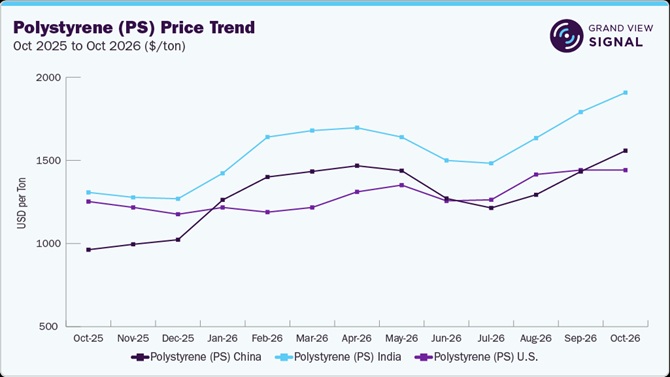
Get Full Access to Price Trends & Market Drivers.
Not every resin experienced the same movement. HDPE rose only 1.7%, partly because ethylene price growth lagged behind propylene. Carbide-based PVC increased 2.5%, reflecting its different feedstock economics.
The divergence demonstrates why buyers need to monitor individual polymer and monomer relationships instead of relying on a single plastics price indicator.
2. China’s Restocking Rally Gives Way to Caution
China’s Golden Week holiday influenced the timing of October’s price movements. Before the break, converters reduced raw material inventories. When factories reopened on October 8, buyers began restocking just as upstream monomer prices reached higher levels.
However, the initial purchasing momentum weakened quickly. LLDPE spot prices flattened after October 16, while PET bottle chip prices declined 2.9% from their October 9 peak as MEG prices softened.
Futures markets also signalled caution: January PP futures traded approximately 13% below spot prices. This suggested that buyers were reluctant to commit to elevated prices after meeting immediate requirements.
The shift from restocking to cautious purchasing highlights the difference between temporary buying activity and sustained industrial demand.
3. Weak Western Demand Restricts Contract Price Increases
The United States and Europe experienced a different market environment. Although feedstock and energy costs increased, converters resisted higher resin contract prices because downstream demand remained subdued and supply was relatively comfortable.
In the United States, polyethylene contracts remained stable, while PVC prices were flat to lower. Spot PP declined 1.6%, and LDPE fell 1.3%.
Europe also faced limited cost pass-through. Ethylene contract prices increased 5.4%, but HDPE film contracts remained unchanged and PP prices advanced only 0.3%.
These developments show that feedstock inflation alone cannot guarantee higher resin prices. Packaging, automotive, and construction demand ultimately influence how much cost producers can transfer to buyers.
4. European Supply Disruptions Contrast with Asian Capacity Growth
Regional operating conditions created another layer of price divergence. Low water levels along Germany’s Rhine River disrupted chemical feedstock deliveries and contributed to Braskem declaring force majeure on PP supplies from its Cologne and Schkopau facilities.
Despite the disruption, German PP prices increased only 0.1%. Weak demand and earlier imports limited the impact on market pricing.
Asia experienced the opposite development. LG Chem restarted its Yeosu cracker in South Korea after a six-month maintenance shutdown, increasing regional monomer and polymer availability.
In India, import offers at Mundra eased despite domestic price increases by producers including IOCL and Reliance. HDPE blow-moulding import quotations declined 2.3%, while LDPE film offers fell 1.6%.
For international buyers, these developments underline the importance of tracking production changes and import economics across individual markets.
5. Gulf Exporters Face Higher Freight and Geopolitical Costs
Saudi Arabia and the UAE remained closely connected to Asian resin pricing because their petrochemical producers export substantial volumes to Asia and India.
Average export resin offers increased 4.3% in Saudi Arabia and 4.4% in the UAE, supported by gains in PS, PP, and ABS.
However, higher shipping expenses also influenced the market. Geopolitical tensions and maritime risks around the Strait of Hormuz kept war-risk insurance premiums elevated. These costs contributed to higher landed prices in destination markets, including Egypt, where average prices increased 3.5%, and Morocco, where they rose 3.2%.
Consequently, resin procurement costs depend not only on the quoted polymer price but also on freight, insurance, and destination-market conditions.
Turning Resin Market Volatility into Procurement Intelligence
Managing polymer costs requires visibility across feedstocks, individual resin grades, regional supply conditions, and international logistics. Buyers who monitor these factors together can better assess price movements, evaluate import alternatives, and prepare for contract negotiations.
Grand View Signal supports this process through real-time pricing intelligence, ten-year historical datasets, predictive modelling, and regional price assessments. Its coverage includes more than 200 commodity price trackers spanning thermoplastics, polyesters, bulk chemicals, and energy feedstocks.
The platform also provides geopolitical and freight risk analytics to help procurement teams evaluate how shipping routes, trade developments, and energy disruptions can influence landed costs.
As global resin markets continue to move at different speeds, data-driven sourcing can help businesses improve price visibility, manage margin exposure, and make more informed purchasing decisions.
Frequently Asked Questions
1. What are the main factors influencing global resin prices?
Monomer costs, crude oil and naphtha prices, downstream demand, inventories, production capacity, freight expenses, and geopolitical risks influence resin prices.
2. Why did Asian resin prices increase during October?
Higher monomer costs, including increases in propylene, styrene, and paraxylene, encouraged Chinese polymer producers to raise prices.
3. Why did U.S. and European resin contracts remain relatively stable?
Weak downstream demand, comfortable supply availability, and converter resistance limited producers’ ability to pass higher feedstock costs on to customers.
4. How do freight costs affect imported resin prices?
Shipping expenses and war-risk insurance premiums increase landed costs, particularly for buyers sourcing polymers from regions exposed to maritime disruptions.
5. How can plastics pricing intelligence support procurement teams?
It helps businesses benchmark regional resin prices, monitor feedstock movements, analyse historical trends, assess supply risks, and use forecasts to support sourcing decisions.