

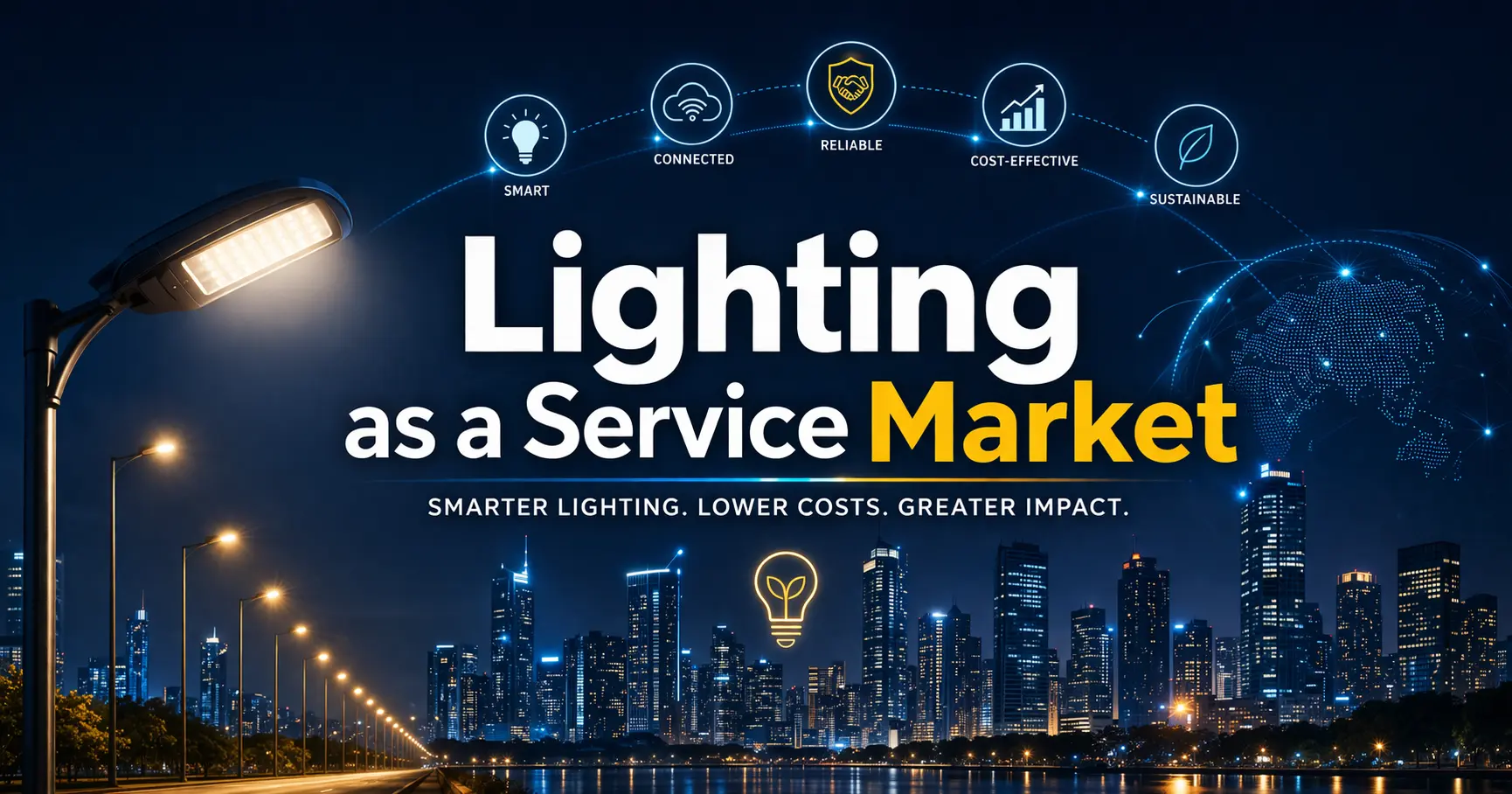
We are all familiar with subscription-based services, whether it is paying monthly for Amazon Prime, Netflix, or a newspaper. Instead of owning the product, we pay a recurring fee to access the service. Lighting as a Service (LaaS) also operates on a similar concept. It allows businesses to upgrade to advanced lighting systems without requiring any upfront capital investment.
Lighting is essential for everyone, but allocating large budgets for upgrades is often challenging. Rather than committing to significant capital expenditure for purchasing and maintaining a new system, LaaS offers a more flexible approach. It covers everything from system design and installation to ongoing operation and maintenance. This enables businesses to adopt modern, connected, and energy-efficient lighting solutions while benefiting from cost savings and improved cash flow from the very beginning.
Lighting accounts for a meaningful share of global electricity consumption, making it one of the fastest-expanding and most cost-effective areas for efficiency upgrades. That alone is pushing businesses to rethink how lighting is financed and managed. The global lighting as a service market stood at $2.56 billion in 2024 and is projected to grow at a CAGR of around 35% from 2025 to 2033.
What LaaS Means for Businesses
Lighting as a Service fundamentally changes the relationship between businesses and infrastructure. Instead of investing capital in lighting systems, companies partner with service providers who install and maintain the entire setup. The business simply pays a recurring fee, often tied to performance metrics like energy savings or illumination levels.
This shifts lighting from a capital expense to an operational one, ensuring that the system is always up to date. Companies such as Signify (formerly Philips Lighting), US LED, ESB, TRILUX, and LumenStream have been actively promoting this model, highlighting how LaaS allows businesses to upgrade to energy-efficient LED and connected lighting without upfront investment, while also outsourcing maintenance and lifecycle management.
Why Commercial Buildings are Leading the Shift
The adoption of LaaS is particularly strong in commercial environments. Office buildings, retail chains, and logistics facilities operate on tight efficiency margins, and lighting often represents a significant portion of their electricity usage. According to the U.S. Department of Energy, switching to LED lighting alone can reduce energy consumption by up to 75% in certain applications.
LED lighting works differently from traditional sources by directing light in a focused path, which reduces the reliance on reflectors or diffusers that often trap and waste illumination. This directional output makes LEDs especially effective for applications like recessed downlights and task lighting, where precision matters. In contrast, conventional lighting systems typically require light to be redirected, and a significant portion fails to exit the fixture.
Another major advantage of LEDs is their minimal heat generation. While incandescent bulbs convert nearly 90% of their energy into heat and compact fluorescent lamps (CFLs) lose around 80% in the same way, LEDs use most of their energy for actual light output. In addition to efficiency, LEDs are far more durable. A high-quality LED bulb can last 3-5 times longer than a CFL and up to 30 times longer than a traditional incandescent bulb.
Recent Examples That Show LaaS in Action
The shift toward Lighting as a Service is already visible in real-world deployments, particularly in large-scale commercial and industrial settings. For example, Signify has implemented the LaaS model at an industrial facility operated by ArcelorMittal in Spain. The project focuses on upgrading lighting infrastructure to improve energy efficiency and working conditions, while removing the need for upfront investment by the client.
Similarly, in March 2025, Swiss sustainable infrastructure investor SUSI Partners extended its partnership with German energy service company Open House of Energy (OHOE) to finance another round of LaaS projects. Since their partnership began in 2018, SUSI has financed 13 of OHOE’s LaaS projects, combining for a financing volume of nearly €15 million.
What is interesting is how these public-sector deployments are influencing private commercial adoption. Business parks and campuses are replicating similar models, treating lighting not as hardware, but as part of a broader digital infrastructure layer.
Final Words
One of the most important shifts in the LaaS market is the evolution of lighting into a data-driven system. Modern lighting networks can track occupancy, movement, and environmental conditions. This data can be used to optimize space utilization, reduce energy waste, and even inform real estate decisions. Companies are not looking at lighting in isolation, they are combining it with solar installations, energy storage, and smart HVAC systems to create a more comprehensive “Energy as a Service” approach.