



Key Highlights
- Iron ore benchmarks weakened as Chinese restocking activity slowed.
- U.S. steel prices strengthened amid disciplined domestic supply.
- European steel costs declined in USD terms due to currency depreciation.
- Semi-finished steel billets recorded the strongest monthly growth.
- Freight disruption and regional price gaps are reshaping procurement decisions.
In this article
A Global Steel Market Defined by Regional Differences
Iron Ore Weakness Brings Raw Material Costs into Focus
Regional Steel Markets Follow Different Pricing Paths
Billets and Scrap Reveal Another Layer of Market Divergence
What the Forward Outlook Means for Procurement Teams
A Global Steel Market Defined by Regional Differences
The global ferrous metals market is experiencing contrasting price movements across regions and product categories. While iron ore prices have softened across major Asian benchmarks, steel prices in the United States have moved higher. European markets have demonstrated another pattern, with stable domestic offers translating into lower costs for international buyers because of currency movements.
These differences highlight why headline commodity prices alone cannot explain the market. Raw material costs, mill capacity management, currency fluctuations, trade flows, and transportation constraints all influence the final procurement cost. For manufacturers, steelmakers, and procurement teams, understanding these interconnected factors is essential to making informed purchasing decisions.
Ferrous metals pricing intelligence helps market participants connect these developments and assess how regional conditions affect sourcing strategies.
Iron Ore Weakness Brings Raw Material Costs into Focus
China’s post-holiday trading environment placed pressure on iron ore benchmarks during October. Muted port activity and limited restocking interest contributed to a decline in the 62% Fe iron ore benchmark delivered at Qingdao, from USD 96.8 per ton on September 22 to USD 91.3 per ton on October 21.
Iron ore futures on the Singapore Exchange also touched USD 89.9 per ton on October 15, their lowest level in two years. China’s broader iron group price average declined 3.2% month-on-month.
However, the correction was not uniform across ore grades. Mid-grade and high-grade materials experienced most of the decline, while 58% Fe lower-grade ore largely maintained its spot value.
This difference reflects the importance of raw material selection when steelmaking margins are compressed. Blast furnace operators can adjust their burden ratios by using more economical lower-grade blends to manage input expenditure. Consequently, monitoring individual ore grades can provide a more useful procurement perspective than relying exclusively on a single benchmark.
Regional Steel Markets Follow Different Pricing Paths
United States — Domestic Supply Discipline Supports Prices
The U.S. steel market moved against the softer Asian raw material trend. Hot-rolled coil (HRC), cold-rolled coil (CRC), and oil country tubular goods (OCTG) recorded price increases of approximately 7% to 8%.
Nucor’s consumer spot HRC price increased from USD 1,210 per short ton in late September to USD 1,255 per short ton by mid-October. Mill lead times remained between three and five weeks, while capacity management and constrained imports supported domestic pricing.
Europe — Currency Movements Change the Cost Equation
European domestic mill offers remained broadly stable in euros. However, steel prices measured in U.S. dollars declined by an average of 2%.
The movement reflected the euro’s depreciation from an average of USD 1.15 in September to USD 1.12 in October. For international buyers paying in dollars, this currency adjustment reduced procurement costs even though local mill offers remained stable.
China — Export Activity Offsets Domestic Weakness
China’s domestic HRC prices declined 1.8%, reflecting weak real estate conditions and subdued manufacturing demand. Steelmakers responded by directing more material toward international markets. September exports reached their highest monthly level of the year, adding competitive pressure to overseas markets receiving Chinese steel.
India and the Middle East — Different Supply Conditions
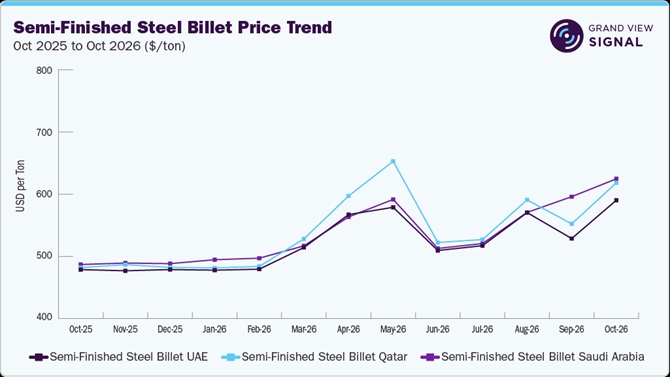
Indian domestic steel prices edged slightly higher despite a temporary festive-season demand slowdown. In the Middle East GCC market, maritime bottlenecks and shipping risks around the Strait of Hormuz restricted import flows. Semi-finished billet import prices consequently reached USD 530–540 per ton.
Billets and Scrap Reveal Another Layer of Market Divergence
Semi-finished steel billets emerged as the strongest-performing tracked ferrous category, recording average month-on-month growth of 9.5% across the top three geographic markets. Regional supply restrictions and changing conversion economics contributed to this performance, although the segment also carried a high volatility rating.
Get Full Access to Price Trends & Market Drivers.
Scrap markets presented a similarly varied picture. U.S. ferrous scrap prices increased by USD 20–30 per gross ton month-on-month as mills raised opening bids to secure October melting requirements. European scrap remained broadly flat in local currencies, while Middle Eastern prices declined amid security-related restrictions on regional exports.
Stainless steel scrap followed a different trajectory. Prices contracted by 2.5% to 4.4% across major regional hubs, reflecting weaker international nickel prices and the resulting reduction in the raw material value of high-alloy scrap.
These differences underline the importance of tracking ferrous and stainless scrap separately rather than treating scrap as one uniform market.
What the Forward Outlook Means for Procurement Teams
The forward forecast curve across primary ferrous benchmarks has flattened significantly through April 2027. Following the early-autumn corrections, futures markets are no longer pricing in further structural declines. This suggests that key raw material and finished steel prices may be stabilizing around current operational baselines.
For procurement teams, this environment calls for a more differentiated approach. Buyers can assess softer Asian spot prices alongside stronger Western market conditions instead of applying one global purchasing assumption. Steelmakers can also retain flexibility in their iron ore burden ratios, considering the relative economics of 62% Fe and 58% Fe materials.
Freight and geopolitical risks deserve equal attention, particularly when sourcing billets and scrap through sensitive maritime corridors. A competitive mill offer may not translate into a competitive landed cost if transportation constraints increase delivery expenses.
Using Market Intelligence to Make Better Sourcing Decisions
Grand View Signal provides market participants with a data-led approach to monitoring ferrous metals pricing developments. By connecting regional assessments with raw material movements, trade conditions, and forward-looking indicators, businesses can develop a clearer understanding of changing procurement conditions.
For organizations managing exposure to iron ore, finished steel, billets, and scrap, ferrous metals pricing intelligence can support more informed purchasing decisions. Rather than responding only to spot-market changes, procurement teams can evaluate regional price differences, input substitution opportunities, and logistics risks together.
In a market where the same commodity can behave differently across regions, timely and granular market visibility is increasingly important.
Frequently Asked Questions
1. What is driving the recent decline in iron ore prices?
Weaker Chinese port trading activity and reduced post-holiday restocking interest contributed to lower iron ore benchmarks during October.
2. Why did U.S. steel prices increase while Asian raw material prices declined?
Domestic capacity discipline, constrained imports, and extended mill lead times supported U.S. steel prices despite softer Asian iron ore benchmarks.
3. How did currency movements affect European steel prices?
European mill offers remained broadly stable in euros, but the weaker euro reduced steel prices by an average of 2% when measured in U.S. dollars.
4. Which ferrous metal category recorded the strongest monthly growth?
Semi-finished steel billets recorded average month-on-month growth of 9.5% across the top three tracked geographic markets.
5. Why is ferrous metals pricing intelligence important for procurement?
It helps buyers evaluate regional price differences, raw material costs, supply conditions, and freight risks when planning sourcing and purchasing decisions.